
Phil Evans' Home
Phil's research
My primary role at present is as a data centre scientist on the Swift post-launch support team, and I am responsible for a number of data centre projects in this role. I am also active in various areas of research at the moment as my Swift duties allow. Naturally given my job, at the moment my role within these projects is heavily focussed on Swift and Swift data, particular that from the X-ray telescope, which is the instrument I am employed to work out. My main research interests are:I also have a range of technical projects.
Multi-messenger astronomy
My primary research interest is the newly-emerging field of “multi-messenger astronomy”. This involves combining the normal ‘messenger’ from space with which we do astronomy (that is, light) with other messengers, such as neutrinos or gravitational waves. This is a new field, because these other messengers are really difficult to detect and we're only now managing to do it. Until recently the only celestial neutrinos we'd detected were from the Sun, or from a nearby supernova in 1987. The first confirmed extra-solar neutrinos since SN1987A were reported in November 2013. Similarly Gravitational Waves were only directly detected for the first time in September 2015..
To date I have led Swift follow up observations and analysis of over twenty possible neutrino detections by the IceCube observatory (Evans et al. 2015), and seven by the ANTARES observatory (Adrián-Martínez et al. 2016). Following up gravitational wave detections with a small field-of-view instrument like the Swift X-ray Telescope is very challenging, and I have led efforts both to reduce the area we need to search and to optimise how we search it (e.g. Evans et al. 2016a) and then performed follow-up observations of LIGO triggers (Evans et al. 2016b, and c).
There are many fundamental physics questions that we can explore in great detail using multi-messenger astronomy, such as understanding how short gamma-ray bursts (below) are powered and convert energy to radiation, but there are two that specifically interest me. First: where did all the heavy nuclear elements in the universe form? Second: Exactly what goes on physically when two compact objects merge? These are discussed in more detail in an article I wrote for my Twitter followers.
GRBs
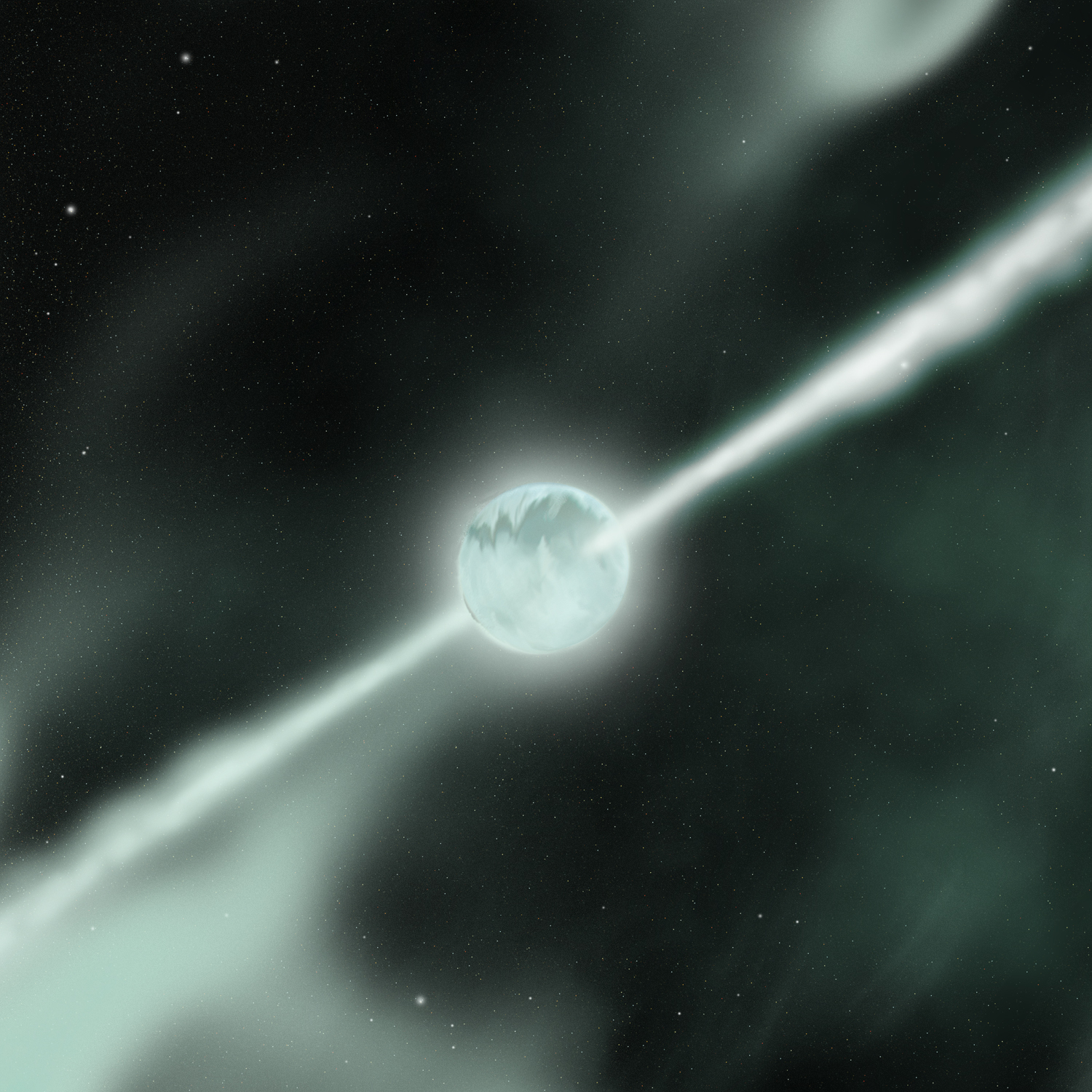
Image Credit: NASA E/PO, Sonoma State University, Aurore Simonnet
Gamma Ray Bursts are the biggest explosions currently known to mankind. A typical GRB gives off a similar amount of energy to a supernova, but it does it in a few seconds, making GRBs around 10,000,000 times brighter than your average supernova. But because they are so short-lived, observing them is not easy. Fortunately, most GRBs also have an afterglow — a longer lived glow of radiation caused when the original fireball smashes into the surrounding medium. These afterglows fade rapidly, so to observe a GRB it is important to start observing as soon as possible after a trigger.
GRBs come in two flavours, long ones (believed to come from the explosive death of really massive stars) and short ones (believed to come from merging neutron stars). The latter are thought to be one of the most likely events to be detected by both gravitational wave detectors and normal telescopes, (see multi-messenger astronomy, above).
My work on GRBs has focussed on the afterglow emission, particularly in X-rays. I published a catalogue of these focussing particularly on the range of behaviours of the different afterglows and whether they could be reconciled to a single model. I have also produced and published a range of tools to help analyse GRB data.
More recently, I've become interested in the question of so-called ‘ultra-long’ bursts: GRBs where the prompt emission — the actual burst of gamma rays — lasts for several thousand seconds. I studied one of these GRB 130925A, which was also unusual in having no standard afterglow in the X-ray band.
For a brief introduction to GRBs, see my Twitter blog post.
X-ray catalogues
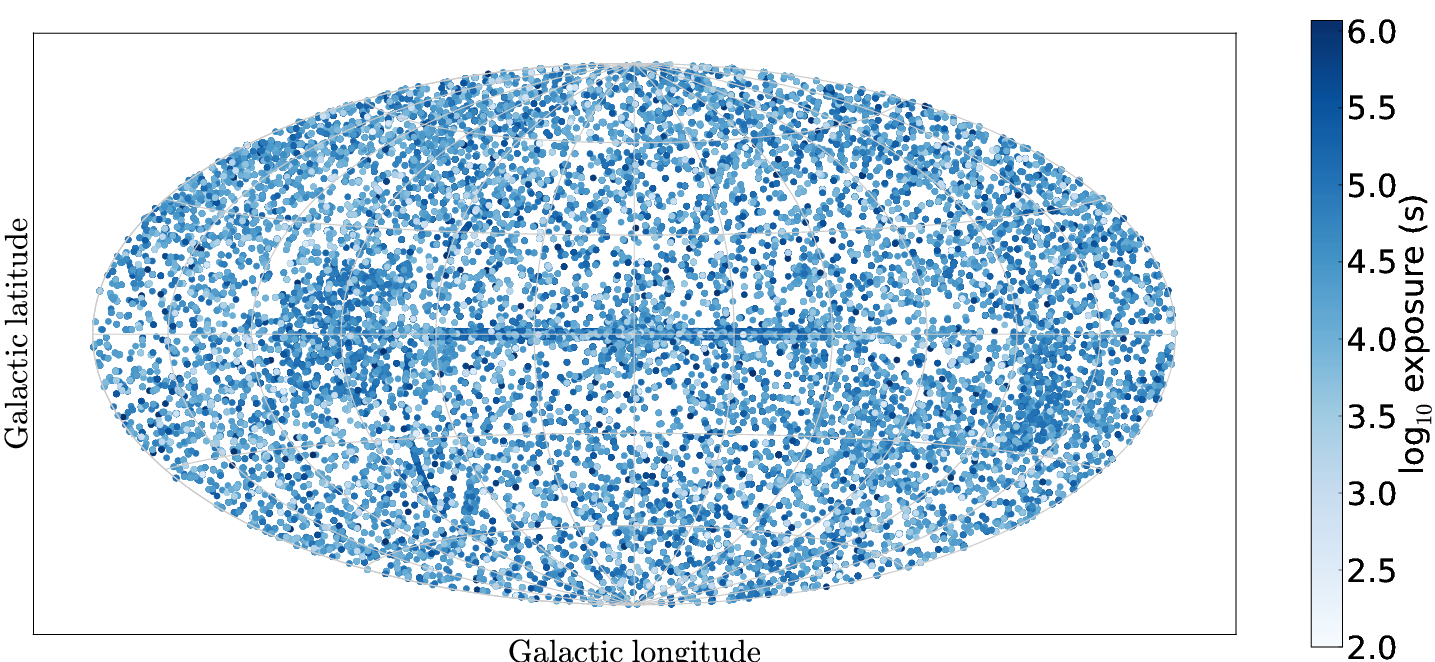
While Swift-XRT performs pointed observations, focussing on a specific target, its 12.3′ radius field of view means that it also serendipitously observes a lot of other sources. In 2014 I published the 1SXPS catalouge. This was the result of searching XRT data from launch up to late 2012 for any point sources, and analysing details (variability, spectrum) of them all. In total, we found about 150,000 X-ray sources.
As the 1 in the name implies, 1SXPS may not be the last version of this catalogue. Watch this space …
X-ray transients
The sky generally is dynamic: objects flare up and fade, and new objects appear and disappaer all of the time. In the same way that Swift-XRT detects serendipitous soureces in its ‘peripheral vision’, so it can detect transients in the same way. I am working on projects to search for such transients and identify them. I've produced a few ATELs on this subject, and hopefully there are many more to come
Swift technical projects
A large part of my job is to develop and maintain facilities to support and aid doing science with Swift-XRT. Facilities I am responsible for include:
- Prompt GRB analysis: analysing the limited real-time XRT data stream we get when a new burst is detected.
- XRT GRB products: automatically-produced positions, light curves, spectra etc.
- The burst analyser: a multi-instrument analysis of Swift GRBs.
- User objects: tools to analyse the XRT data of any XRT point source.
- Recent transient database: an automatically-populated and searchable database, which trawls things like ATELs for recent positions.